
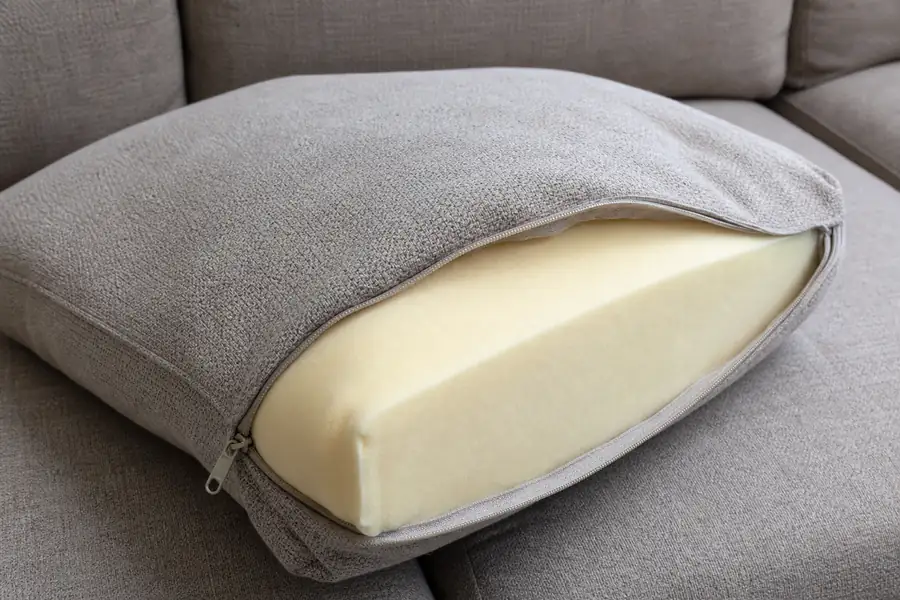
A couch cushion is three things stacked together, and each one is cleaned differently.
There is the cover, which may or may not come off and may or may not be washable. There is the foam or fiber core inside it, which is a sponge and the reason sofas hold smells. And there is whatever has soaked between the two.
Almost all bad outcomes here come from treating it as one object - putting a dry-clean-only cover through a hot wash and shrinking it, or wet-cleaning a fixed cushion and leaving a damp core that smells a week later. So start with two checks that take half a minute.
Key Takeaways
- Check for a zip first. A removable, washable cover turns this into a laundry job and changes everything.
- Then check the care label and the cleaning code - W, S, WS or X. On S and X, water is not an option.
- Cold wash, gentle cycle, air dry on covers. Heat shrinks covers so they no longer fit the foam - the most common irreversible mistake.
- Put covers back slightly damp, where the fabric allows, so they dry to shape on the foam.
- Foam holds many times what the surface shows, and it is the reason a cushion still smells after the cover is clean.
- Drying foam takes 24 to 48 hours or more. A damp core becomes a mold problem.
- Vacuum seams every month. Most of what is in a cushion is dry soil that water would turn to mud.
Step 1: Does the cover come off?
Look along the back and underside of each cushion for a zip. Many sofas have them, and plenty of owners have never noticed.
If there is a zip, check the care label inside it. You may find it is machine washable, which makes the whole job straightforward. Go to Method A.
If there is no zip, or the label says dry clean only, go to Method B.
A caution on zips: a zip does not automatically mean washable. Some covers are zipped purely for manufacture and will shrink or distort in a wash. The label governs, and if there is no label, treat it as not washable.
Step 2: Find the cleaning code
Either way, find the code - on a tag under the cushions, under the seat deck, or on the underside of the frame.
| Code | Means | Consequence here |
|---|---|---|
| W | Water-based cleaning safe | Full range of options |
| S | Solvent only, no water | Water causes rings and browning. No wet cleaning, no machine wash |
| WS | Either, applied lightly | Proceed, dry fast |
| X | Vacuum only | No water, no solvent. Professional only |
Using the wrong agent causes color bleeding, shrinkage, texture distortion or large water rings, and that damage is frequently irreversible. Full detail in upholstery cleaning codes.
Step 3: Vacuum, before anything else
Whichever method follows, do this first. Most of what is in a cushion is dry particulate - skin, crumbs, dust, pet dander, fiber - and adding water to dry soil makes mud that bonds to the fabric far more stubbornly.
- Remove the cushions from the sofa and vacuum both faces and all four sides.
- Crevice tool into every seam and piping line. This is where the majority of it collects.
- Vacuum the seat deck and the frame underneath, which nobody does and which is always worse than expected.
- Get the pet hair off first if there is any - wet hair mats together and clogs everything. A rubber squeegee dragged across the fabric in one direction is the fastest tool. See how to remove pet hair from a couch.
Method A - washing removable covers
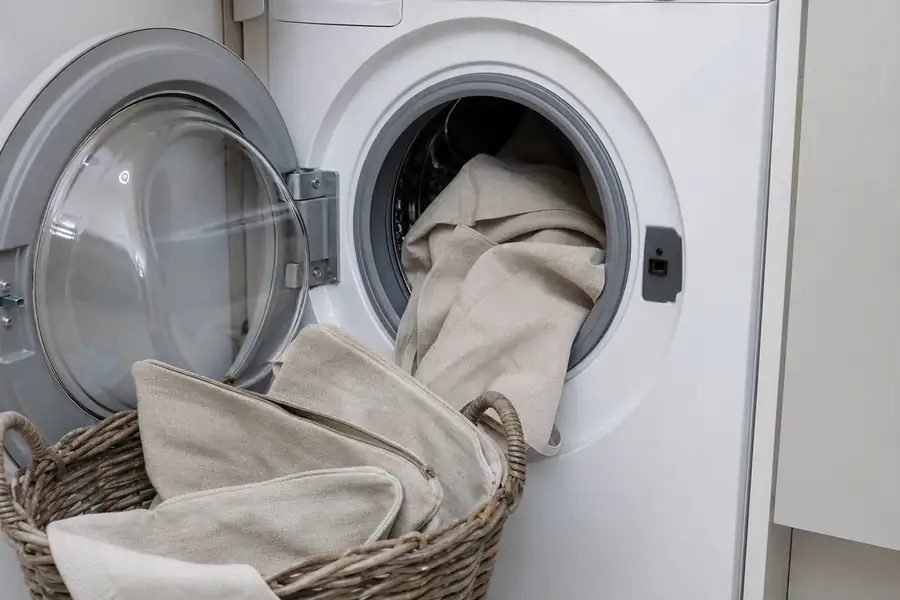
The label governs. Where it permits machine washing:
- Unzip and remove all the covers at once, and wash them together so any slight color change is uniform across the set. Washing one cushion cover alone is how you end up with one cushion that does not match.
- Close the zips before washing, so they do not catch the fabric.
- Turn them inside out to protect the face of the fabric.
- Cold water, gentle cycle, mild detergent. Cold is not caution for its own sake - heat is what shrinks covers, and a cover that has shrunk even slightly will not go back over its foam. That is the most common unrecoverable mistake here.
- No bleach. And no fabric softener, which leaves a residue that attracts soil.
- Air dry, never tumble dry. A dryer is heat and agitation together, which is shrinkage twice over.
- Dry flat or over a rack, out of direct sunlight, which fades fabric unevenly.
- Put them back slightly damp where the fabric allows. A marginally damp cover stretches over the foam more easily and then dries to shape, which gives a noticeably better fit than a bone-dry one. Do not do this if the foam is at all damp.
If the label says dry clean only, believe it and take the covers to a dry cleaner, or treat them in place as Method B. A dry-clean-only cover in a washing machine is usually ruined in one cycle.
Method B - cleaning fixed cushions
Where the cover does not come off, you are cleaning in place, and the discipline is moisture control.
On W or WS fabric:
- Vacuum thoroughly, as above.
- Mix a weak solution - a few drops of clear, dye-free dish soap in cool water, or a water-based upholstery cleaner at the stated dilution. Weak beats strong; residue attracts soil.
- Test in a hidden spot - the underside of a cushion, the back panel against the wall - and let it dry fully before judging.
- Apply with a damp cloth, not a spray, wrung out so it does not drip.
- Work from seam to seam, not spot by spot. A seam is a natural boundary; the eye accepts a difference at a seam that it will not accept mid-cushion.
- Feather the edges. Never leave a hard wet boundary, because as water evaporates it migrates to that edge and deposits the soil it picked up - which is how you get a ring that is more visible than the stain was.
- Rinse by going over the area with a cloth dampened in clean water only, then blot dry hard with a dry towel.
- Dry with airflow - a fan across the surface - and keep off it until dry.
On S fabric: no water. Use a water-free dry-cleaning solvent or isopropyl alcohol on a white cloth, misted lightly and blotted, with the room ventilated and no open flames. The method is the same as for microfiber couches, which are frequently S-coded and where water rings are the classic failure.
On X fabric: vacuum and brush only. Anything more needs professional treatment.
Step 4: The foam core
This is the part that matters for smells, and the part people miss.
Foam is a sponge. It holds many times the liquid the surface mark suggests, which is why a cushion can have a perfectly clean cover and still smell. If something soaked in - a drink, a pet accident, a child - the cover is not the problem.
Not sure when your carpets were last deep cleaned?
Get an exact price online in about two minutes. No phone tag, no surprise fees.
Get My Instant QuoteIf the cover comes off and the foam needs attention:
- Press out what you can with towels, using body weight through a thick pad. Foam gives up a lot of liquid to pressure, and this is the only way to remove liquid from foam.
- For odor, treat the foam directly. Pet accidents need an enzyme cleaner with protease, applied generously enough to reach the depth the liquid reached, covered so it stays damp for the full dwell time. The chemistry is in how to get pee smell out of a couch.
- Rinse by pressing clean cool water through and pressing it out again, two or three times.
- Do not put foam in a washing machine. Agitation tears it apart.
- Dry it properly. Stand the foam on edge so air reaches every face, with a fan on it. Expect 24 to 48 hours at minimum, and several days for a thick seat cushion.
- Do not reassemble until the core is completely dry. Squeeze the center - any dampness at all and it needs longer. The EPA advises drying wet materials within 24 to 48 hours to limit mold, and the inside of a damp cushion is comfortably above the 60% humidity mold needs.
When replacing the foam is the better answer: a large accident that soaked right through, repeated accidents in the same cushion, odor that has survived two proper enzyme treatments, or foam that is old and crumbling anyway. Replacement foam cut to size is a modest cost against a sofa, and it resolves the problem completely. Keep the cover, replace the core.
Reviving flat, tired cushions
Often the complaint is not dirt at all.
- Flip and rotate every month. Most sagging is uneven compression, not failure.
- Beat them outdoors to redistribute fiber fill and knock out dust.
- Fiber-filled cushions can be re-fluffed; foam cushions that have collapsed cannot, and need new inserts.
- Add a foam wrap or batting layer inside the cover to firm up a slightly flat foam core.
- Brush the nap back on pile fabrics once dry - microfiber and velvet look patchy until the pile is lifted, and a lot of "it still looks dirty" is really flattened nap.
Frequently Asked Questions
How do you clean couch cushions?
Vacuum both faces and all seams first. If the covers unzip and the label permits, wash them all together in cold water on a gentle cycle and air dry. If they do not come off, clean in place according to the cleaning code - a weak water-based solution on W fabric, solvent only on S, vacuum only on X.
Can you wash couch cushion covers in the washing machine?
Only if the care label says so. Where it does: zips closed, inside out, cold water, gentle cycle, mild detergent, air dry. Never tumble dry - heat shrinks covers so they no longer fit the foam.
How do you clean couch cushions that cannot be removed?
Clean in place by cleaning code, working seam to seam with minimal moisture and feathered edges, then rinse with clean water and dry with a fan. On S-coded fabric use a solvent or rubbing alcohol instead of water.
Why does my cushion still smell after I washed the cover?
Because the smell is in the foam core, not the cover. Foam holds far more liquid than the surface shows, and odor from a spill or pet accident needs the foam treating directly.
How long does cushion foam take to dry?
At least 24 to 48 hours with air reaching every face, and several days for a thick seat cushion. Do not reassemble until the center is completely dry.
Can you put cushion foam in the washing machine?
No. Agitation tears foam apart. Press out liquid with towels and body weight, rinse by pressing water through, and air dry.
Should I put covers back damp or dry?
Slightly damp is better where the fabric allows - the cover stretches over the foam more easily and dries to shape. Only if the foam itself is completely dry.
How often should couch cushions be cleaned?
Vacuum seams monthly, flip and rotate monthly, and have the pieces that get daily use professionally cleaned about once a year.
When to hand it over
Three cases: an S or X coded fabric where you cannot use water, cushions that do not open with contamination inside them, and a sofa good enough that a water ring across one cushion would cost more than the clean.
Our upholstery cleaning is matched to the fabric code, with extraction powerful enough to pull soil and moisture back out of the depth of a cushion rather than leaving it in the foam - which is the specific thing a cloth and a household machine cannot do. We also clean rugs and vehicle interiors.
25+ years, 50,000+ customers, removing 99% of allergens, biodegradable solutions, no upsells at the door, come-back guarantee. Call (855) 507-8955 or get a free quote.