
A sofa is a worse problem than a carpet, and for a reason that has nothing to do with the fabric.
When a pet or a child has an accident on a couch, very little of the liquid stays in the upholstery. It passes through the cover in seconds and soaks into the foam cushion core, which is a block of sponge sitting under the surface. Foam holds many times what the visible mark suggests, and no amount of blotting from the top will bring it back out.
So you clean the fabric, the stain disappears, and the sofa smells fine for a week or two. Then it warms up or the humidity rises, and the smell is back. The fabric was never the problem.
Key Takeaways
- The foam core is the reservoir, not the fabric. It cannot be blotted out, which is why surface cleaning always fails.
- Uric acid crystals cause the lasting smell. They are not meaningfully water-soluble, so water-based cleaning leaves them behind.
- Humidity reactivates them, which is why the smell returns in warm or damp weather.
- Check the cleaning code first. On S or X fabric, water will ring or damage the upholstery before it reaches the foam.
- Enzyme cleaners with protease are the only thing that breaks the crystals down - and they need volume, dwell time and moisture.
- Unzip the cushion if you can. Treating the foam directly is the difference between solving this and managing it.
- Drying the foam is the hard part. A damp foam core becomes a mold problem, so airflow for days, not hours.
Why the smell keeps coming back
Two mechanisms stack up here, and both have to be addressed.
The chemistry. Fresh urine is mostly water, urea, urochrome, uric acid, bacteria and ammonia. As it dries, bacteria break the urea down into ammonia and then into uric acid crystals. Those crystals are not meaningfully water-soluble. They bind into the fabric, the foam and the frame webbing and stay there.
Water-based cleaners - including vinegar and baking soda, which are both water-based - remove the liquid, the yellow color and the ammonia smell. The crystals are untouched. Then humidity rehydrates them and the odor goes airborne again. That is the whole explanation for why the smell comes and goes with the weather, and why the sofa seems to smell worse in summer.
The geometry. On carpet, the reservoir is the carpet pad and the subfloor beneath it, and at least you can get a machine over the top of it. On a sofa, the reservoir is a foam block wrapped in fabric inside a frame. There is no way to extract from the bottom, there is no way to flush it through, and the foam holds far more liquid than the surface mark implies. A 4-inch stain on a cushion face routinely means a saturated area several times that size inside the foam.
This is why the answer to "how do I get pee smell out of a couch" starts with "can you get the cushion open".
Step 1: Check the cleaning code before anything wet
Find the tag - under the cushions, under the seat deck, or on the underside of the frame.
| Code | Means | What you can do here |
|---|---|---|
| W | Water-based cleaning safe | The full method below applies |
| S | Solvent only, no water | Water will leave rings and may cause browning. Enzyme products are water-based - see below |
| WS | Either, lightly | Proceed carefully, dry fast |
| X | Vacuum only | Professional treatment only |
This is a real conflict and worth being straight about. Enzyme cleaners are water-based, which means that on an S or X coded fabric you cannot use them on the visible upholstery without risking rings or damage. If your cushion cover unzips, the way through is to treat the foam directly with the cover removed, and have the cover itself cleaned by the method its code allows. If the cover does not come off and the code is S or X, this is a professional job. More on codes in upholstery cleaning codes.
Step 2: Find all of it
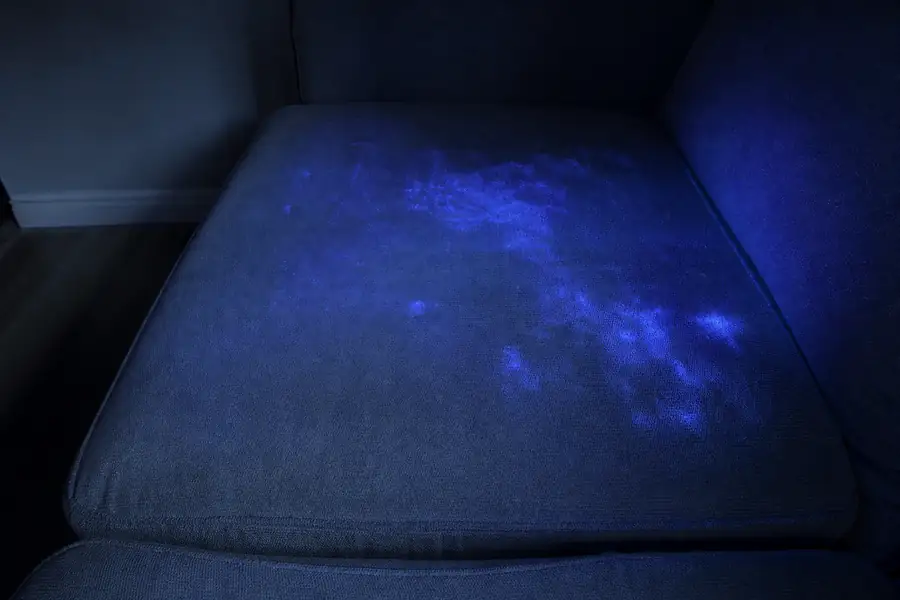
Urine fluoresces under UV. Take a black light to the sofa in a darkened room and check:
- Both faces of every cushion, and the sides
- The seat deck underneath the cushions
- The back and arm panels, and down the sides
- The base and the frame webbing underneath
- The floor and baseboard around and behind the sofa
Mark what you find. As with carpet, expect more spots than you remember and larger spots than you can see.
Step 3: Fresh accidents - the first few minutes decide everything
Caught wet, you can often prevent the whole problem.
- Blot immediately and hard. Paper towels or white cloths, pressed down firmly and lifted. Press with your body weight through a thick pad of towels to draw liquid up out of the foam - this is far more effective than dabbing, and it is the only moment when you can remove liquid from foam.
- Keep going with fresh towels until nothing more transfers.
- Never rub. It spreads the contamination and damages the fabric surface.
- Remove the cushion from the sofa and work on it on a hard floor where you can press properly.
- Unzip the cover if you can and blot the foam directly. This is the most useful thing available to you.
- Cold water only. Urine is a protein stain and heat sets protein into fiber permanently. No steam cleaner.
- Then treat with enzymes anyway, as below. Preventing crystals is much easier than dissolving them.
Step 4: Set accidents - enzyme treatment on foam
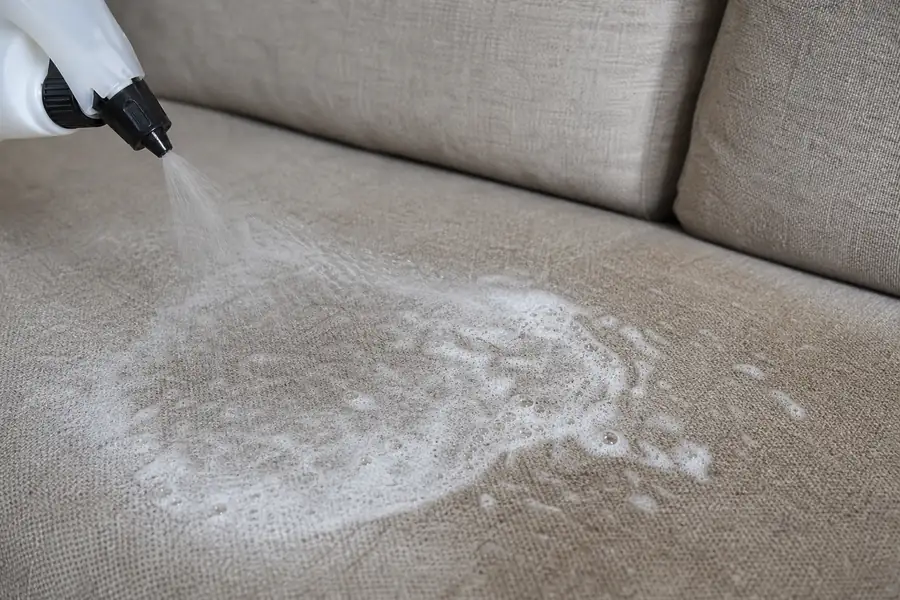
Enzyme cleaners containing protease break uric acid crystals down into simple odorless compounds. Three rules decide whether they work.
Use enough. The product has to reach all the contamination. On foam that means soaking the affected area - considerably more product than feels sensible. Being sparing is the most common reason enzyme treatment fails. You are trying to wet the same volume of foam the urine wet.
Give it dwell time. Enzymes are biological catalysts and need time and moisture. Typically hours; for old contamination, 24 hours or more. Cover the treated area with plastic, because enzymes stop working the moment they dry out.
Do not mix it with anything. Alkaline and oxidizing chemicals denature enzymes and make the product inert. If you have already used vinegar, baking soda, upholstery shampoo or an oxygen cleaner, rinse with clean water and let it dry before applying an enzyme product.
The method, for a cushion whose cover comes off:
- Unzip and remove the cover. Deal with it separately, by its cleaning code - many covers are machine washable, which solves that half entirely. Check the label.
- Take the foam somewhere you can work - a bathtub, a shower pan, outside on a hard surface.
- Press out what you can with towels first.
- Saturate the contaminated area of the foam with enzyme cleaner, out past the edge of what the black light showed.
- Cover with plastic and leave for the full dwell time, longer for old contamination.
- Press out the excess with towels, hard and repeatedly. Walking on a towel-wrapped cushion works.
- Rinse by pressing clean cool water through and pressing it out again, two or three times. Removing the dissolved residue matters - leftover product attracts soil and can smell on its own.
- Dry it thoroughly, which is the hard part. See Step 5.
- Re-check with the black light when dry, and repeat on anything still glowing.
If the cover does not come off: you can apply enzyme product through the fabric on W coded upholstery, accepting that you cannot extract it well afterward and that drying will be slow. It is worth trying for a modest accident. For a large or repeated one, the realistic options are professional extraction or replacing the foam.
Step 5: Drying foam - do not skip this
A damp foam core is a mold problem, and mold in a cushion you sit on is a worse outcome than the smell you started with.
Not sure when your carpets were last deep cleaned?
Get an exact price online in about two minutes. No phone tag, no surprise fees.
Get My Instant Quote- Press out every bit of water you can. Towels, body weight, repeatedly. Foam gives up a great deal of water to pressure.
- Airflow, both sides. Stand the foam on edge so air reaches all faces, with a fan on it.
- Expect 24 to 48 hours at minimum, and longer for a thick seat cushion. Thick foam can take several days.
- Do not use high heat. It can degrade the foam and set any residual protein.
- Do not put the cover back on until the foam is completely dry all the way through. Squeeze the center - if there is any dampness at the core, keep going.
- Do not put the cushion back on the sofa damp.
The 24-to-48-hour benchmark comes from the EPA's guidance on drying wet materials to limit mold growth; mold can begin colonizing organic materials within 24 to 72 hours wherever humidity exceeds 60%. The inside of a damp foam cushion is comfortably above 60%.
When replacing the foam is the right answer
Sometimes it is, and it is often cheaper than people assume.
Consider it when: the accident was large and soaked right through; there have been repeated accidents in the same cushion; the smell has survived two proper enzyme treatments; or the foam is old and already breaking down. Replacement foam cut to size is a modest cost against a sofa, and it resolves the problem completely in a way that treating saturated foam sometimes cannot.
Keep the cover, replace the core, clean the cover by its code. For a sofa worth keeping, that is frequently the best outcome available.
Stopping it happening again
- A washable waterproof-backed throw on the sofa while you work on the behavior. Unglamorous and extremely effective.
- Animals return to places they have marked, and they smell what you cannot - which is another reason to decontaminate fully rather than mask.
- Keep an enzyme product in the house so a fresh accident never becomes a set one.
- Rule out a medical cause. A sudden change in bathroom habits in a previously reliable pet warrants a vet visit - urinary tract infections, diabetes and kidney disease all present this way. For a child, the same logic applies with a pediatrician.
- Waterproof cushion protectors under the covers, if this has happened more than once.
Frequently Asked Questions
How do I get pee smell out of a couch?
Unzip the cushion cover if you can and treat the foam core directly with an enzyme cleaner containing protease, saturating the full contaminated area and covering it so it stays damp for the full dwell time. Press out the excess, rinse, and dry the foam completely with airflow to all faces before reassembling. Clean the cover separately by its cleaning code.
Why does the pee smell come back on my couch?
Uric acid crystals left behind by water-based cleaning rehydrate in humidity and release odor again. They are in the foam core, which surface cleaning never reaches.
Does vinegar get urine smell out of a couch?
Only briefly. Vinegar is water-based and cannot dissolve uric acid crystals, and it adds moisture to foam that is hard to dry.
Does baking soda work on urine in a sofa?
It absorbs some surface moisture and airborne odor. It does nothing to crystals inside the foam.
Can I use a steam cleaner on urine on a couch?
No. Urine is a protein stain and heat sets it permanently. It also drives moisture deeper into foam that then will not dry.
What if my sofa cushions do not unzip?
On W coded fabric you can treat through the upholstery, accepting slower drying and weaker extraction. On S or X fabric, or for a large accident, this needs professional treatment.
Should I just replace the cushion foam?
Often the best answer for a large or repeated accident, or where two enzyme treatments have not worked. Replacement foam is inexpensive relative to a sofa and resolves it completely.
Can the smell get into the sofa frame?
Yes - liquid passes through the cushion into the deck, the webbing and the frame. Check all of it with a black light, because an untreated deck will keep the smell alive after perfect cushion work.
When to have it done
The three cases where professional treatment is the realistic option: an S or X coded fabric where you cannot use water, cushions that do not open, or contamination that has reached the deck and frame.
Our upholstery cleaning is matched to the fabric code, with extraction powerful enough to pull treatment solution and contamination back out of the depth of a cushion rather than leaving it in the foam - which is the specific thing a household attempt cannot do. For carpet with the same problem, pet-odor treatment is $50 per room alongside a $60 standard room clean, with 10% off when you book online; see carpet cleaning.
25+ years, 50,000+ customers, removing 99% of allergens, biodegradable solutions, no upsells at the door, come-back guarantee. Call (855) 507-8955 or get a free quote.