
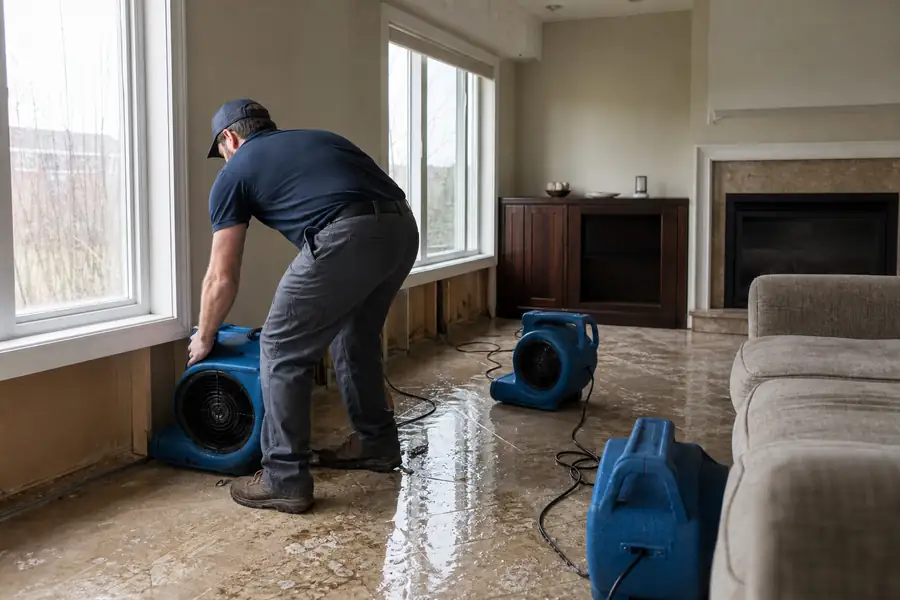
Water damage restoration is the process of returning a building to its pre-loss condition after water has got in where it should not be. In practice it is two jobs wearing one name, and knowing the difference tells you what you are being quoted for.
Mitigation is the emergency half: stopping the damage getting worse. Extraction, drying, removing materials that cannot be saved. It happens in the first hours and days, and it is usually treated as necessary under a homeowners policy whether or not an adjuster has attended.
Restoration is the rebuilding half: replacing the drywall, flooring and finishes that were removed, and putting the room back.
Most people asking this question are about to pay for one or both, so here is what each stage involves and roughly how long it takes.
Key Takeaways
- Mitigation stops the damage; restoration repairs it. Two phases, often two quotes, sometimes two companies.
- The water's category sets the scope. Clean (1), gray (2), or black (3) under the IICRC S500 industry standard - it determines what can be dried and what must be cut out.
- Clean water does not stay clean. Category 1 degrades to Category 2 after roughly 24 to 48 hours of dwell time.
- The EPA advises drying wet materials within 24 to 48 hours to limit mold growth.
- Drying is measured, not timed. Equipment stays until moisture readings hit target, typically 3 to 5 days.
- Dryness is a meter reading, not a feeling. A floor can feel dry with a wet subfloor beneath it.
- Average restoration runs $3,833, typically $1,364 - $6,301 (HomeAdvisor).
First: what category of water is it?
Before anything else, a competent responder establishes what kind of water they are dealing with, because it changes everything downstream. The industry standard, IICRC S500, classifies water by contamination into three categories.
Category 1 - clean water. From a sanitary source: a broken supply line, overflow from a clean-water appliance, rainwater that has not contacted contaminated surfaces. Most materials can be dried in place and saved.
Category 2 - gray water. Significantly contaminated. Washing machine and dishwasher discharge, toilet overflow with no solids, water that has passed through building materials. Porous materials become questionable; some must be removed.
Category 3 - black water. Grossly unsanitary, including sewage and floodwater, carrying pathogens. Porous materials - carpet, carpet pad, drywall, insulation - are generally removed rather than dried, and the work requires containment and protective equipment.
The point that costs people money: these categories are not fixed at the moment of the leak. A Category 1 event degrades into Category 2 after roughly 24 to 48 hours of dwell time, depending on temperature and the organic content of the wet materials. Clean water sitting in carpet and carpet pad becomes a bacterial medium.
So the same burst pipe produces two completely different jobs depending on when it is addressed. On day one: extract, dry, keep the carpet. On day four: possibly remove the carpet and carpet pad, cut back drywall, treat for microbial growth. The water did not change. The clock did.
That is also why the 24 to 48 hour window keeps coming up. The EPA advises drying wet or damp materials within that window to help prevent mold growth, and mold can begin colonizing organic materials within 24 to 72 hours wherever relative humidity exceeds 60%.
Stage 1 - Inspection and assessment
Typically: 1 to 2 hours, on arrival.
Nothing gets dried properly without knowing where the water is, and water travels in ways that are not intuitive. It runs along joists, wicks up drywall, spreads under flooring and emerges in a room nobody suspected.
What happens:
- Source identification and shutoff, if not already done.
- Category determination, as above.
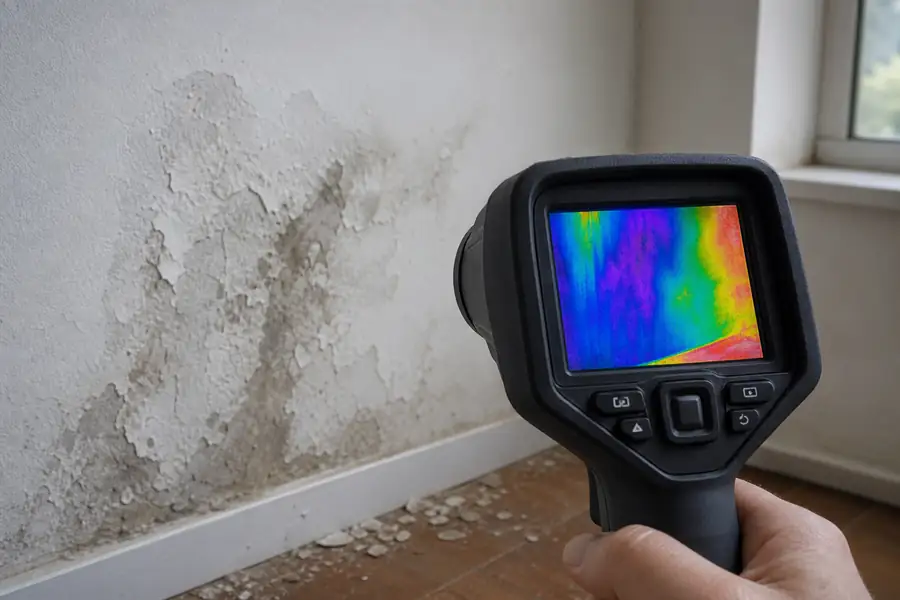
- Moisture mapping with moisture meters and often thermal imaging, room by room, including walls, subfloor and cavities. Thermal imaging shows temperature differences caused by evaporation, which reveals wet areas behind surfaces.
- Scope of affected materials - what is wet, how wet, and what can realistically be saved.
- Documentation - timestamped photographs and written readings.
That last point is worth more than it sounds. This documentation is what your insurance adjuster needs, and it has to be gathered before cleanup disturbs the evidence. Mitigation and documentation compete with each other, which is why this stage comes first. More on that in who to call for water damage.
Stage 2 - Water extraction
Typically: a few hours to a day, depending on volume. Begins immediately.
Standing water comes out first, because every hour it sits it is soaking into something.
- Truck-mounted or portable extraction units remove standing water fast - orders of magnitude faster than any domestic equipment.
- Carpet and carpet pad extraction. Water in the backing and carpet pad is the part domestic machines cannot reach. Our truck-mounts run at 400+ PSI, which pulls water out of the backing rather than driving it deeper.
- Decisions on removal. Saturated carpet pad is often unsalvageable even when the carpet above it is fine, because it holds water against the subfloor. Carpet pad is cheap; a subfloor is not.
- Lifting and blocking. Furniture off wet flooring, with foil or plastic under the feet so wood stain and metal rust do not bleed into damp carpet - marks that are usually permanent.
Stage 3 - Structural drying and dehumidification
Typically: 3 to 5 days, longer for dense materials or large losses.
This is the stage that decides whether the job worked, and the stage DIY attempts fail at.
- Air movers create high-velocity airflow across wet surfaces, speeding evaporation. Positioning matters - angled along surfaces rather than pointed into them.
- Dehumidifiers pull the evaporated moisture out of the air. Without them, air movers move humidity from the floor into the room and then into your walls.
- Drilling, drying mats, and removing baseboards to get airflow into cavities and under flooring where needed.
- Daily monitoring. Readings are taken each day against drying targets, and the equipment stays until the targets are met.
That last point is the whole discipline: drying is finished when the readings say so, not when the floor feels dry. A hardwood floor can feel perfectly dry while its subfloor holds enough moisture to cup the boards weeks later. Carpet can feel dry on top while the carpet pad beneath is still wet enough to grow mold under a reinstalled floor. This is the most common failure in a DIY dry-out, and it is invisible until it is expensive.
Stage 4 - Cleaning, sanitizing and odor control
Typically: 1 to 2 days, often overlapping with drying.
- Antimicrobial treatment where the water category warrants it.
- Cleaning salvageable contents and textiles - carpet, upholstery, rugs. Rugs that have taken water are usually better handled off-site, where the foundation can be treated properly.
- Odor control. Musty smell after water damage is microbial, and it comes from material that did not dry fast enough. It is addressed at the source, not masked.
- Disposal of removed materials, documented.
Stage 5 - Restoration and repair
Typically: days to weeks, depending on scope.
Not sure when your carpets were last deep cleaned?
Get an exact price online in about two minutes. No phone tag, no surprise fees.
Get My Instant QuoteThe rebuilding phase: replacing drywall, insulation, flooring, trim and paint; reinstalling or replacing carpet and carpet pad; and returning the room to its pre-loss condition.
This is frequently a separate quote and sometimes a separate contractor, which is worth clarifying up front. Mitigation is usually billed as emergency work; restoration is a construction job with its own timeline and its own insurance treatment.
What it costs, and what insurance does with it
HomeAdvisor puts average water damage restoration at $3,833, with a typical range of $1,364 to $6,301. Large losses, Category 3 water and multi-room events run well beyond that.
On insurance: Insurance Information Institute data shows water damage and freezing accounts for 22.6% of all home insurance claims, averaging $15,400, with about 1 in 60 insured homes filing one each year. Standard policies cover water damage that is sudden and accidental and exclude gradual leaks, seepage and maintenance failures - and water damage carries roughly a 10% denial rate, the highest of any category, almost entirely because of that exclusion.
Two practical consequences. First, emergency mitigation generally does not require you to wait for an adjuster; standard policies impose a duty to mitigate, so acting fast is what the policy expects. Second, the sudden-versus-gradual determination turns on evidence of timing - which is gathered in Stage 1, on day one. Detail in does homeowners insurance cover water damage and, for tenants, does renters insurance cover water damage.
How to tell a competent job from a poor one
Useful if you are choosing between quotes:
- They moisture-map before they quote, and can tell you where the water went, not just that the room is wet.
- They give you readings, and ideally a daily log.
- They explain the water category and what it means for what can be saved.
- Drying targets are stated, and equipment stays until they are met rather than for a fixed number of days.
- They document for your insurer as standard.
- They are clear about where mitigation ends and restoration begins, and which they are quoting.
Warning signs: a fixed-duration drying quote given before any assessment, no moisture readings offered, pressure to sign a wide-ranging authorization on the spot, or an insistence on removing everything porous when the water is clean and the loss is fresh.
Frequently Asked Questions
What is water damage restoration?
The process of returning a property to its pre-loss condition after water intrusion. It covers mitigation - extraction, structural drying and removing unsalvageable materials - and restoration, the repair and rebuilding that follows.
What is the difference between water mitigation and water damage restoration?
Mitigation stops the damage getting worse and happens in the first hours and days. Restoration repairs and rebuilds what was damaged or removed. They are often separate phases with separate quotes.
How long does water damage restoration take?
Structural drying typically runs 3 to 5 days, with assessment and extraction in the first day. Repair and rebuilding can take days to weeks depending on scope. Drying finishes when moisture readings reach target, not on a fixed schedule.
How much does water damage restoration cost?
HomeAdvisor puts the average at $3,833, with a typical range of $1,364 to $6,301. Category 3 water and multi-room losses cost considerably more.
Can I do water damage restoration myself?
For a small, fresh, clean-water spill, sometimes. The failure mode is that surfaces feel dry while the subfloor, carpet pad or wall cavity is still wet - which is how cupped floors and hidden mold happen. Dryness is a moisture-meter reading.
What are the water damage categories?
Category 1 is clean water from a sanitary source, Category 2 is significantly contaminated gray water, Category 3 is grossly unsanitary black water including sewage and floodwater. Category 1 degrades to Category 2 after roughly 24 to 48 hours.
Will my carpet be saved?
Often yes if it is clean water extracted quickly; the carpet pad is more frequently a write-off because it holds water against the subfloor. Category 3 water generally means removal regardless.
If this is happening now
The window matters more than anything else on this page. Within 24 to 48 hours you have a clean-water event and most materials can be dried in place. Past it, the category changes and so does the scope.
Our water damage restoration covers extraction and structural drying, and we handle the soft surfaces - carpet, upholstery and rugs - in-house rather than subcontracting them, with truck-mounted extraction above 200°F at 400+ PSI.
25+ years, 50,000+ customers, biodegradable solutions, no upsells at the door, come-back guarantee. Call (855) 507-8955 or request a free quote.