
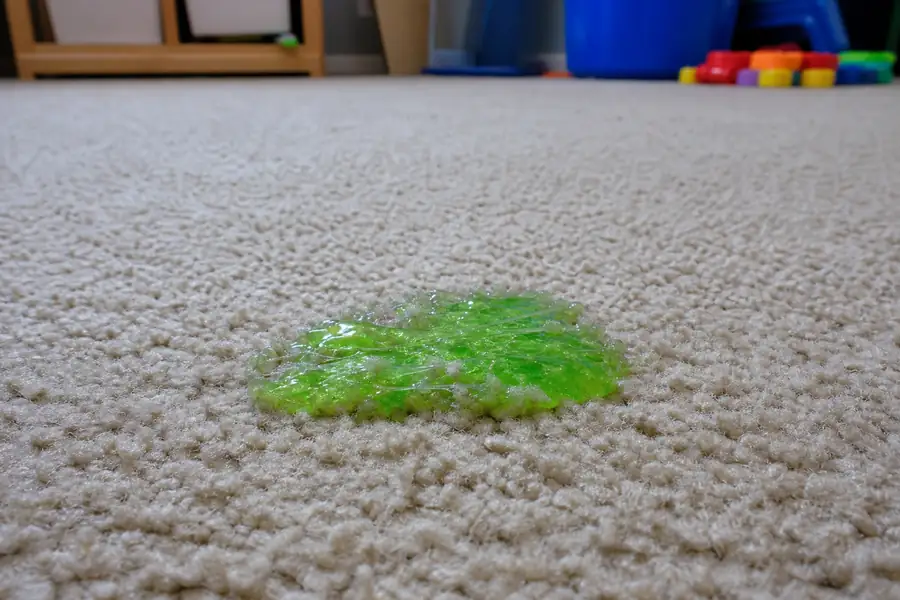
Slime is a polymer, and that is why the instinctive response - grabbing at it and scraping - makes the situation measurably worse.
Household slime is PVA glue cross-linked with a borate, usually from borax or contact lens solution. That cross-linking is what turns runny glue into a stretchy solid, and it means slime has to be chemically broken down rather than lifted off. Scrape at it dry and you shatter it into the pile, pushing fragments and dye deep into the carpet backing where nothing will reach them.
Here is the method that works, followed by the five other messes that tend to arrive in the same week.
Key Takeaways
- Do not scrape dry. Scraping fragments the slime into the pile and drives the dye into the backing.
- Break the cross-links first. White vinegar is the household option; it dissolves the borate bonds and turns the slime back into something liftable.
- Keep it wet while you work. Reapply as it evaporates - it cannot dissolve dry.
- Ice is the alternative approach. Freeze it solid and it becomes brittle enough to break off cleanly in one piece.
- The dye is the second job. Removing the slime does not remove the color. Treat them separately.
- Cold water for anything protein-based, and never heat on an unknown stain.
- Act before it cures. Fresh slime is a ten-minute job; cured slime is an hour.
Step 1: Remove the bulk, without scraping
Lift off what is sitting on top of the pile with your fingers or the edge of a spoon, pulling upward and inward rather than pushing across. Slime sticks to slime, so pressing a larger lump of fresh slime onto the stuck remainder will often pick a good deal of it up - the most effective first move, and children enjoy it.
Do not: scrub, use a stiff brush, or attack it with a dry scraper.
Step 2: Choose your method
Method A - Vinegar (the main approach)
White vinegar is acidic and breaks the borate cross-links, reverting the slime toward liquid glue.
- Soak the slime with white vinegar, undiluted. Be generous. Some people prefer a 2:1 vinegar-to-warm-water mix, which works slightly more slowly but is gentler on the carpet.
- Leave it 5 to 10 minutes. The slime should soften and start to break down.
- Keep it wet. Reapply as it evaporates. This is the step that gets skipped and it is the step that matters - dissolution cannot happen in a dry patch.
- Work gently with an old toothbrush, loosening slime from the fibers rather than grinding at them.
- Blot with a white cloth, outside in, changing cloth faces often.
- Repeat. Several patient cycles beat one aggressive attempt.
- Rinse by blotting with cool clean water, then blot dry hard.
Test the vinegar in a hidden spot first. It is acidic, and on wool it needs diluting - one part vinegar to four parts cool water - because wool is permanently damaged outside roughly pH 5 to 8 and undiluted vinegar sits near pH 2.5. See how to clean a wool rug.
Method B - Ice (good for large or thick lumps)
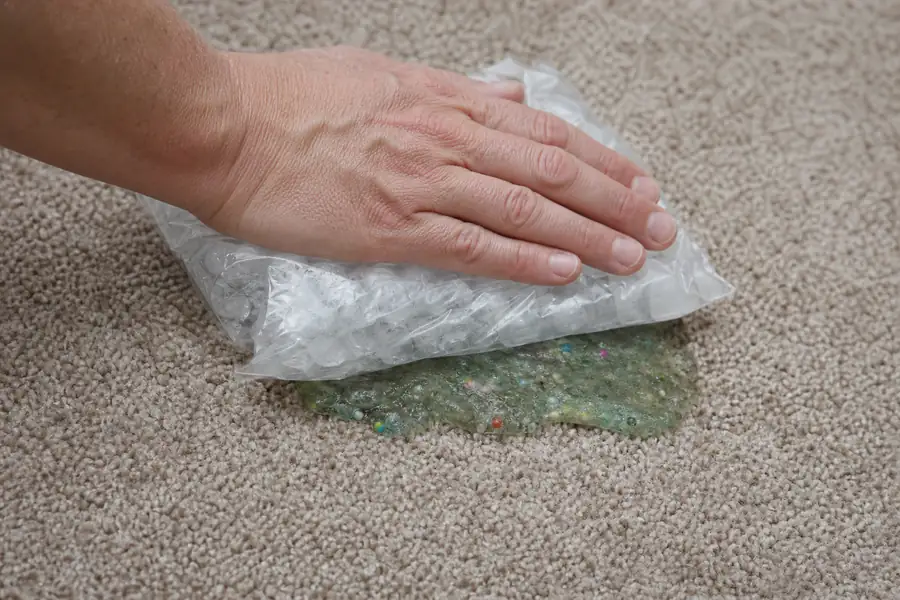
- Pack ice in a plastic bag over the slime for 10 to 15 minutes until frozen solid.
- Break it off. Frozen slime becomes brittle and usually lifts away in pieces rather than smearing.
- Follow with vinegar on whatever remains.
This is the better first move on a large lump, because it removes most of the material before any liquid is involved.
Method C - Rubbing alcohol
Isopropyl alcohol works on the residue and is particularly good at lifting the dye. Apply to a cloth rather than the carpet, blot, repeat. Ventilate the room, and keep it away from open flames.
Step 3: The dye is a separate problem
Removing the slime does not remove the color, and bright slime is heavily dyed. Once all the polymer is out:
- Dish soap in cool water - a teaspoon in a cup - applied with a cloth, left a couple of minutes, blotted outside in.
- Rubbing alcohol on a white cloth for stubborn color.
- Hydrogen peroxide (3%) as a last resort on white or light synthetic carpet only. It fades dyes, especially on wool, silk and dark carpet. Never on wool. Test in a hidden spot and let the test dry fully before judging.
- Rinse with cool water and blot dry, then dry with a fan and vacuum once dry.
Step 4: Dried, cured slime
Harder, usually still recoverable. Same principle: soften, never scrape.
- Vacuum around it to clear loose debris.
- Saturate with vinegar and give it 15 to 20 minutes, reapplying so it never dries.
- Work it with a toothbrush, picking loosened pieces out with tweezers - tedious and very effective on textured carpet.
- Repeat the cycle several times.
- Treat the dye as above once the polymer is gone.
- Trim fused fiber tips as an absolute last resort, with small sharp scissors. You lose a little pile height, which is usually invisible on cut-pile carpet once vacuumed. On loop pile - Berber especially - be very careful, because cutting a loop can start a run.
The other five
Play dough
Let it dry completely first - this is counterintuitive and correct. Wet play dough smears and works into the pile; dried play dough is crumbly. Once dry, break it up and vacuum it out, then treat any remaining color with dish soap in cool water. Resist the urge to deal with it immediately.
Crayon
Crayon is wax and pigment, so heat is both the tool and the risk. Scrape off the surface wax with a dull knife. Then lay a white paper towel over the mark and touch a warm iron to it briefly - the wax melts into the towel. Move to a clean part of the towel and repeat. Keep the iron low and moving: too much heat melts synthetic carpet fiber and sets the pigment. Finish the color with rubbing alcohol or a detergent solution.
Glitter
More logistics than stain. Vacuum first. Then lift the remainder with sticky tape wrapped around your hand, or a lint roller, working in small patches. A damp cloth gathers the fine particles a vacuum leaves behind. Expect to find glitter for months; this is the human condition.
Chewing gum
Freeze it. Ice in a bag for 10 to 15 minutes until hard, then break and lift it off. Remove residue with a dab of rubbing alcohol or a little smooth peanut butter, oddly enough, which works because the oil breaks down the gum base - then clean the oil out with dish soap.
Permanent marker
The hardest of the five. Rubbing alcohol on a white cloth, blotting rather than rubbing, from the outside in, changing cloth faces constantly because the ink spreads readily. Hairspray sometimes works for the same reason - it contains alcohol. Accept that permanent marker on carpet sometimes lives up to its name.
The rules that apply to all of them
- Blot, never rub. Rubbing spreads the mess and frays the fiber tips so the spot looks dull even after the color is gone.
- Outside in, always.
- Cold water for protein stains - milk, yogurt, blood, vomit. Heat cooks protein into the fiber permanently. See how to get blood out of carpet.
- Test everything in a hidden spot and let it dry before trusting it.
- Rinse properly. Detergent residue left in the pile attracts dirt and will create a dark patch within two weeks.
- Dry with airflow and vacuum once dry.
Why it came back
If a mark reappears after you successfully removed it, the timing tells you which of two things happened.
Not sure when your carpets were last deep cleaned?
Get an exact price online in about two minutes. No phone tag, no surprise fees.
Get My Instant QuoteWicking, within 24 to 72 hours: material soaked through to the backing or carpet pad, and as the carpet dried, capillary action pulled it back up. It returns in the original shape. Re-treat with minimal moisture and extract thoroughly.
Resoiling, over one to two weeks: detergent residue attracting dirt. It shows as general darkening with no distinct outline. Rinse with clear water and extract.
More in how to remove carpet stains.
Frequently Asked Questions
How do you get slime out of carpet?
Lift the bulk off without scraping, then soak it with white vinegar for 5 to 10 minutes, keeping it wet, and work it gently with a toothbrush. Blot from the outside in, repeat as needed, then treat the remaining dye separately with dish soap in cool water or rubbing alcohol.
Does vinegar remove slime from carpet?
Yes - vinegar is acidic and breaks the borate cross-links that make slime a solid, turning it back toward liquid glue so it can be lifted. Dilute it on wool.
Can you get dried slime out of carpet?
Usually. Soften it with vinegar over repeated cycles, never scraping dry, working it loose with a toothbrush and picking pieces out with tweezers.
Will a carpet cleaner remove slime?
Not on its own, and running a machine over slime spreads it. Break the slime down and remove it first, then clean the area.
How do I get the color out after removing slime?
Dish soap in cool water, then rubbing alcohol on a white cloth if color remains. Hydrogen peroxide only on white or light synthetic carpet, tested first - never on wool.
How do I get play dough out of carpet?
Let it dry completely, then break it up and vacuum it out. Treating it wet smears it into the pile.
Does ice work on slime and gum?
Yes, for both. Freezing makes them brittle so they break off in pieces instead of smearing.
When it is not worth the afternoon
There is a point at which a room with young children in it stops being a series of individual stains and becomes a carpet that needs a proper clean.
Our truck-mounts run above 200°F at 400+ PSI, removing 99% of allergens, with biodegradable solutions and no upsells at the door. Published rates: $60 a standard room, $35 a hall or landing, $60 a staircase, and 10% off automatically when you book online - so a playroom and the hall it opens onto is a straightforward job.
25+ years, 50,000+ customers, and a come-back guarantee. See carpet cleaning, call (855) 507-8955, or get a free quote.