
Two very different people ask this question, and they need opposite answers.
If your carpet was just professionally cleaned, you are waiting on a normal process. Expect 6 to 12 hours, often less. Nothing is wrong, and the rest of this page tells you what affects it and how to speed it up.
If your carpet is wet because something leaked, overflowed or flooded, this is not a waiting question. You have roughly 24 to 48 hours before mold becomes the bigger problem, and wet carpet left to air-dry on its own frequently does not dry in time. Skip to the wet carpet section - or go straight to who to call for water damage.
Key Takeaways
- After professional cleaning: 6 to 12 hours on average, with a full range of 30 minutes to 72 hours depending on method.
- After a DIY rental machine: 12 to 24 hours, because consumer machines leave far more water behind.
- Wool takes at least 24 hours. Polyester 6 to 12. Deep plush pile 12 to 24.
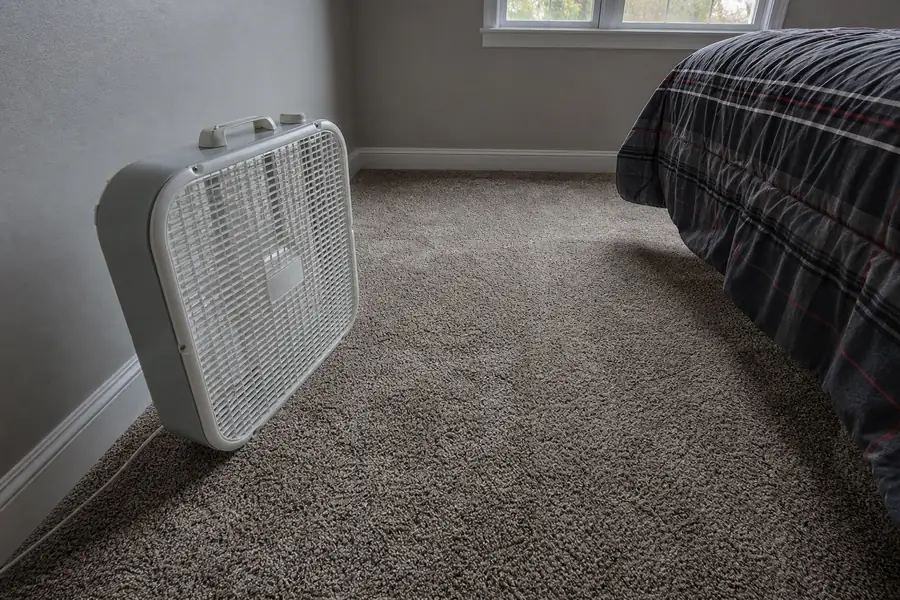
- Airflow matters more than heat. Fans across the surface, plus a dehumidifier.
- The method sets the floor: dry compound 30-60 minutes, encapsulation 1-2 hours, hot water extraction 6-24 hours - or 2 to 6 with strong extraction and air movers.
- Still damp at 48 hours is a problem, not a delay. The EPA advises drying wet materials inside 24 to 48 hours to limit mold.
- It is the water that comes back out that decides this, not the water that goes in.
After a professional clean: what to expect
The average is 6 to 12 hours, and the realistic full range across all methods is 30 minutes to 72 hours.
That spread is almost entirely about method and extraction power. Here is what each approach produces:
| Method | Typical dry time |
|---|---|
| Dry compound cleaning | 30 minutes - 1 hour |
| Encapsulation | 1-2 hours |
| Very low moisture (VLM) | 2-4 hours |
| Shampooing | 6-10 hours |
| Hot water extraction (what most people call steam cleaning) | 6-24 hours, or 2-6 hours with strong extraction and air movers |
| Steam cleaning with no drying equipment at all | 24-72 hours |
Note the gap in that last pair. Hot water extraction is the same method whether it is done with a rental machine or a truck-mount - what differs is how much of the water comes back out, and that single variable moves the dry time from a couple of hours to three days. More on that below.
Our own work runs above 200°F at 400+ PSI, which is why a carpet clean is normally dry in hours rather than overnight.
What changes the time
Extraction power - the big one. Consumer-grade machines have significantly lower suction than professional equipment, so more moisture stays in the carpet and the carpet pad. That is why DIY cleans typically run 12 to 24 hours against a professional pass at the low end of the range. It is not a detergent difference. It is a suction difference.
Humidity. High indoor humidity slows evaporation; dry air speeds it up. This is why the same clean dries in three hours in February and eight in August.
Airflow. Moving air across the surface carries moisture away and lets more evaporate. This is the most useful thing you can do, and it beats heat.
Fiber.
- Polyester: 6 to 12 hours
- Nylon: similar, sometimes slightly faster
- Olefin / polypropylene: fast, since the fiber is hydrophobic - but see Berber carpet, which should usually be cleaned by low-moisture methods anyway
- Wool: at least 24 hours. Wool is a protein fiber that absorbs a great deal of moisture, and it must not be rushed with heat. See how to clean a wool rug
Pile depth. A deep plush pile holds more water and takes 12 to 24 hours. Low pile dries considerably faster.
How soiled it was. Heavily soiled carpet needs more solution and more passes, which means more moisture going in.
The carpet pad. The pile can feel dry while the carpet pad beneath it is still wet. This is the one that matters, and it is covered below.
How to speed it up
- Floor fans, aimed along the carpet rather than down into it. Oscillating fans at floor level, moving air across the whole surface. This is the highest-value action.
- Run a dehumidifier in the room with the door closed. Removing moisture from the air is what lets more leave the carpet.
- Open windows only if the outside air is drier. On a humid or rainy day, opening windows imports moisture and slows everything down. Check before you commit.
- Run the HVAC fan to keep air circulating.
- Air conditioning helps - it dehumidifies as it cools.
- A wet vac pass over the carpet pulls out excess moisture if you have one. Dry passes with the trigger off are surprisingly effective.
- Keep off it. Walking on damp carpet re-soils it immediately, crushes the pile, and presses surface moisture back down into the carpet pad.
- Keep furniture off until it is fully dry. Wooden feet bleed stain and metal feet rust into damp carpet, and those marks are usually permanent. Foil or plastic coasters if something has to go back.
What not to bother with: a hairdryer (tiny coverage, and heat sets any protein stain that is still there), or cranking the heating without ventilation, which just raises humidity in a closed room.
How to tell if it is actually dry
The pile dries long before the backing and the carpet pad do, which is why "it feels dry" is not the test.
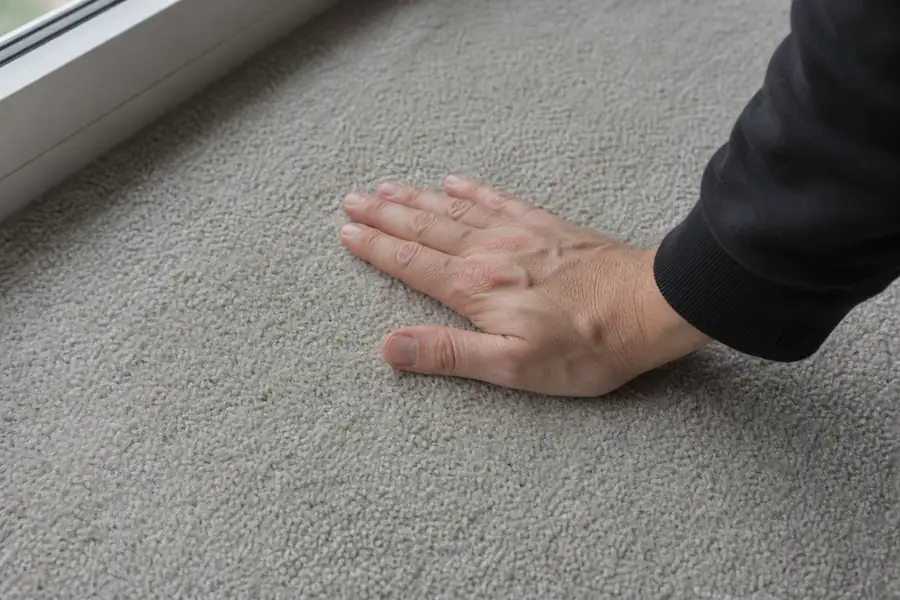
- Press a white paper towel firmly into the carpet with your palm, or stand on it. If any moisture transfers, it is not dry.
- Check the traffic lanes and the edges, which hold more water.
- Check under where furniture was, if anything was left in place.
- A musty smell is the clearest sign something did not dry fast enough - that smell is microbial, and it means the moisture stayed too long.
Wet carpet after a leak or flood
This is the other question, and it is a different problem entirely.
Air-drying wet carpet on its own is usually not good enough. When water has come from a leak, an overflow or a flood, it has not just wet the pile - it has gone through the carpet into the carpet pad and down to the subfloor, and those are the layers that will not dry on their own in a sealed room. Without drying equipment, carpet in that state can take 24 to 72 hours or longer, and that is past the deadline.
The deadline. The EPA advises drying wet materials within 24 to 48 hours to help prevent mold growth, and mold can begin colonizing organic materials within 24 to 72 hours wherever relative humidity exceeds 60% - which a wet room is by definition.
There is a second clock as well. Under the industry's IICRC S500 standard, clean Category 1 water degrades into contaminated Category 2 after roughly 24 to 48 hours of dwell time. So delay risks mold and also changes what can be saved: on day one the carpet is usually dried in place, and by day four the carpet pad is often a write-off and the drywall may need cutting back.
What this means practically:
Not sure when your carpets were last deep cleaned?
Get an exact price online in about two minutes. No phone tag, no surprise fees.
Get My Instant Quote- Household fans will not reliably dry a wet carpet pad. Professional work uses air movers plus dehumidifiers, and dries to measured moisture readings rather than to a fixed number of days.
- Saturated carpet pad is frequently unsalvageable even when the carpet above it is fine. It holds water against the subfloor. Carpet pad is cheap; a subfloor is not.
- Dryness is a meter reading, not a feeling. This is the most common and most expensive DIY failure - the carpet goes back down over a damp subfloor and mold grows underneath, out of sight.
- If the water was not clean, the calculation changes again. Toilet overflow, sewer backup and floodwater are Category 2 or 3, and porous materials are generally removed rather than dried.
Full detail in what is water damage restoration, the call order in who to call for water damage, and the insurance side in does homeowners insurance cover water damage.
Why slow drying causes the problems people blame on cleaning
Three complaints that are really drying complaints:
A musty smell afterwards. Microbial growth in carpet or carpet pad that stayed damp too long. The fix is faster drying, not more cleaning.
Stains coming back after 24 to 72 hours. This is wicking - contamination in the backing or carpet pad rising to the surface by capillary action as the carpet dries from the top down. It returns in the original stain's shape. See how to remove carpet stains.
A flattened, matted look. Walking on damp carpet crushes the pile while the fibers are soft. Stay off it, and vacuum once dry to lift the pile back up.
Frequently Asked Questions
How long does carpet take to dry after cleaning?
On average 6 to 12 hours after a professional clean, and 12 to 24 hours after a rental machine, because consumer machines leave more water behind. Strong truck-mounted extraction with air movers can bring it down to 2 to 6 hours.
How long does it take wet carpet to dry after a leak?
Without drying equipment, 24 to 72 hours or longer - and that is past the point where mold becomes likely. The EPA advises drying wet materials within 24 to 48 hours. Wet carpet from a leak needs air movers and dehumidifiers, and the carpet pad often needs replacing rather than drying.
Can I walk on carpet while it is drying?
Better not to. Foot traffic on damp carpet re-soils it, crushes the pile and presses moisture back into the carpet pad. If you must cross it, clean socks or shoe covers.
How can I make carpet dry faster?
Floor fans aimed across the surface, a dehumidifier with the door closed, air conditioning, and windows open only if the outside air is drier than the inside. Stay off the carpet and keep furniture off it.
Why is my carpet still wet after 24 hours?
Usually under-extraction - more water went in than came out - combined with high humidity or poor airflow. If it is still wet after 24 hours, add aggressive airflow now, because you are approaching the mold window.
Does wool carpet take longer to dry?
Yes, at least 24 hours, because wool absorbs considerably more moisture than synthetics. It also should not be force-dried with heat.
Is it bad if carpet stays wet too long?
Yes. Past 24 to 48 hours you are into mold risk, musty odor and, where the water came from a leak, a change in the water's contamination category that expands the whole job.
How long before I can put furniture back?
Only once the carpet is fully dry, tested by pressing a paper towel into the pile. Damp carpet takes stain from wooden feet and rust from metal ones, usually permanently.
If it is still wet and should not be
Two situations are worth a phone call rather than another day of waiting: carpet that is still damp more than 24 hours after a clean, and carpet that is wet because of a leak.
For the first, if we did the clean, contact us within 48 hours and we re-clean the area at no charge. For the second, speed is the whole game - truck-mounted extraction at 400+ PSI pulls water out of the backing rather than pushing it deeper, which is the difference between drying a carpet and replacing it. See water damage restoration.
$60 a standard room, $35 a hall or landing, with 10% off when you book online. 25+ years, 50,000+ customers, biodegradable solutions, no upsells at the door. Call (855) 507-8955 or request a free quote.